
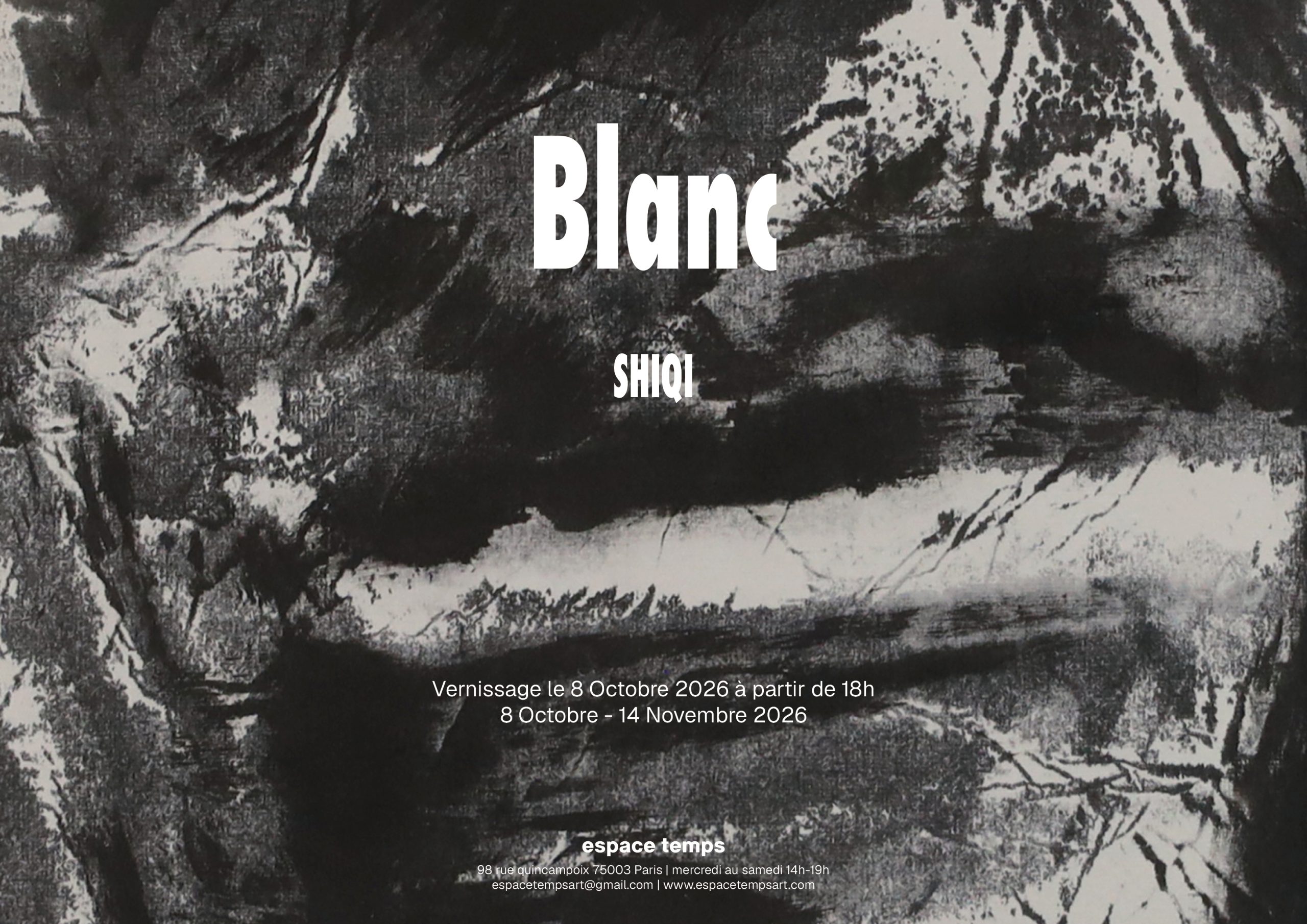
White
8 October 2026 – 14 November 2026
Opening 8 October 2026 from 6pm
Artist
SHIQI
On the Path of Ink with SHIQI
Patricia Castex Menier
In the beginning was the gesture. Then came movement. The movement that would guide the path, that would decide the path. That of life, which hangs by a thread; its very fragility makes it an object of celebration, of writing, of painting. Hanging by a thread—the thread of time which, from birth to death, will one day hang by no more than a hair, a white hair. Then imposes itself the form that the brush seeks from the well of ink, that it draws from the black to deposit upon the white paper: this very form is that of the character “white” (blanc). Here it is, this white, or rather its face, or rather its faces, or even—since everything is a matter of gaze—the faces confronting it: that of the painter at work, our own contemplating it, or the faces of time succeeding one another on the thread of life. A few strokes at first, distinct yet already fusing, each born of the other, a living calligraphy: whether the black signifies the white transcends paradox; the painting happily joins the fertile alliance of opposites, an exchange where, yes, the black speaks of the white, the ink speaks of the paper. Nothing is fixed. Let us watch the character open, dilate; let us watch it tighten, close in upon itself: does the black release the white, or does it imprison it? Does the white enter or exit—yet moreover, as the support of the sign, has it not always been there? To translate the character as “whiteness” would be a mistake: whiteness is an idea, white is a being; it has the presence of a being, a reality merely underscored by the character that constructs it. Later, everything blurs, superimposes, merges; does the character disappear partially or completely, letting itself be covered with scribbles, overflowing until illegible, or radiating with clarity like a fire glowing at the heart of the sun, or swelling to the point of explosion? Ultimately, who (what) wins over whom (what)? Neither victory nor defeat, but an alternation that, far beyond black and white, speaks to us of day and night, of shadow and light: we follow with our eyes the thread of time, the thread of life, its faces, its variations. Until the ultimate moment, which proves to be the most evident simplification: with the appearance—oh surprise!—of color, this diaphanous pink background, the pink of dawn, the white character is truly white, and its neat form might well be that of a door, the absolute door, the dreamed-of opening.
In the beginning was the gesture. Then wings were born. Wings of ink, wings of moths. Of the night because they fly in the night, or because they are made of night? What path do they take, what do they seek to reach as they head seemingly almost all in the same direction? What horizon is figured by this background—sometimes light, the paper’s white as if in torn pieces, sometimes more or less dark until it becomes the mass of obscurity—diluted ink, spread in layers? Here everything palpitates, a movement of life from the outside to the inside, from the surface to the depth: forms of ink that sometimes graze the expanse of the paper, sometimes penetrate it. Is it straying? One might hear the rustling of a grouped flight, a pulsation that the elegance of the stroke renders light yet stubborn. Moths, as we know, burn their wings in contact with a flame, a lightbulb; the irrepressible temptation of light, whatever the dangers, and its fatal end. A trajectory that, from birth to death, summarizes the entire definition of living. Implicitly, we find the white hair once more… though in a mode so different in duration, the thread of time is embodied this time by these frantic butterflies of such brief existence: before our gaze, they are saved by the beauty of the ink’s gesture—source of light and dark, of day and night, of shadow and light—which, by alternating, superimposing, or blending these opposites, restores all the energy of desire toward the desirable.
In the beginning was the gesture. Then the forms faded away. Infinitely light, they gather, pressed together in varied arrangements that, white themselves, barely appear within the white. It is their greyed contours that play with our gaze, with its limits, its poor power of distinction, and its eternal ambition to know and to name; thus, it cannot help but wonder: wings or petals? But why define at all costs? Let our attention instead enter absolute transparence, let it follow the movement of these evanescent forms, let it welcome these simple ghost-like presences. Ghosts? To think thus liberates another image of time, the becoming of each person after the white hair… beings and things live having abandoned their thickness, passing us by, brushing against us, investing the air for a moment while leaving only fleeting traces behind. One might blow on them as upon dust, yet they remain; the gaze here dialogues with the four different arrangements of the forms and their four distinct ways of positioning themselves within the rectangle of the paper, as if successively reaching the four cardinal points of the world. In this space of harmony declined in four windows, the visible and the invisible superimpose without weight.
In the beginning was the gesture. Then the strokes engendered one another. A diptych this time. On the left—if one still and always had to ask the question—flower-butterflies, or butterfly-flowers? A profusion of beating wings or opening and closing corollas? Against an openwork grey background, the whole is compact, gathering into a darker core where everything merges, a centrifugal movement from the aerial toward the rooted, unless it is the reverse: a centripetal movement of dispersion, a core dislocated into light parts detaching from one another. On the right, against a light background, everything opens up, simplifies: an escape, a movement of freedom upward, and between the forms, a breathing space of the expanse. The birth of butterflies or the flight of flowers, butterflies brought into life by the flowers and carrying them away together. Stroke after stroke, stroke upon stroke, wing and petal travel together, blending until they become one. Then appears the primordial—that is to say, the osmosis of all forms of life. One always transforms into the other, like a chrysalis into a butterfly, a calligraphic character into an open door, a silhouette into a ghost, a black hair into a white hair… A metamorphosis that the gesture of ink invites us to follow with our gaze, a universal process that would be another figure of time, this thread of time passing from birth to death, this path of life at the tip of the brush.
Artist
SHI Qi
Based in Hangzhou starting in 1997, Shiqi trained within the Experimental Painting Department at the China Academy of Art (CAA). She traveled throughout Western China, notably to Guizhou and Shaanxi. She graduated with a pictorial installation titled “Hongzhuang” (Red Makeup), a reflection on women’s marriage in contemporary China.
After spending time in Shanghai and Beijing, Shiqi pursued her studies in France at the École nationale supérieure d’arts de Paris-Cergy (ENSAPC) starting in 2002. She expanded her training to new media, particularly video. She traveled across Europe and the United States while continuing to make regular visits to China. Her work, resonating with these journeys, records her reactions to these various environments. While engaging with subjects connected to Chinese material culture through media like video, she extended her ink practice and adapted it to contemporary themes.
For nearly a decade, she explored—in ink or oil—various themes related to the experience of motherhood, from gestation to childhood. In 2007, she was deeply moved by the baby boom in China associated with the cyclical Year of the Pig. The various manifestations of Asian and European consumer society fed her vision of childhood, which she expressed through her creations during this period.
In 2017, her work underwent a formal turning point. She developed a gestural painting style conceived in part as a reminiscence of written signs. This exploration of the line led her beyond the purely pictorial frame to engage ink and paper in three dimensions. Starting in 2020, she produced works made from calligraphic or pictorial fragments whose forms resemble books with unknowable contents—transcending the meaning of words and figures. Continuing in this direction, she exhibits this work on the borders of painting, sculpture, and installation across Europe and Asia. Blanc is her second collaboration with espace temps.