
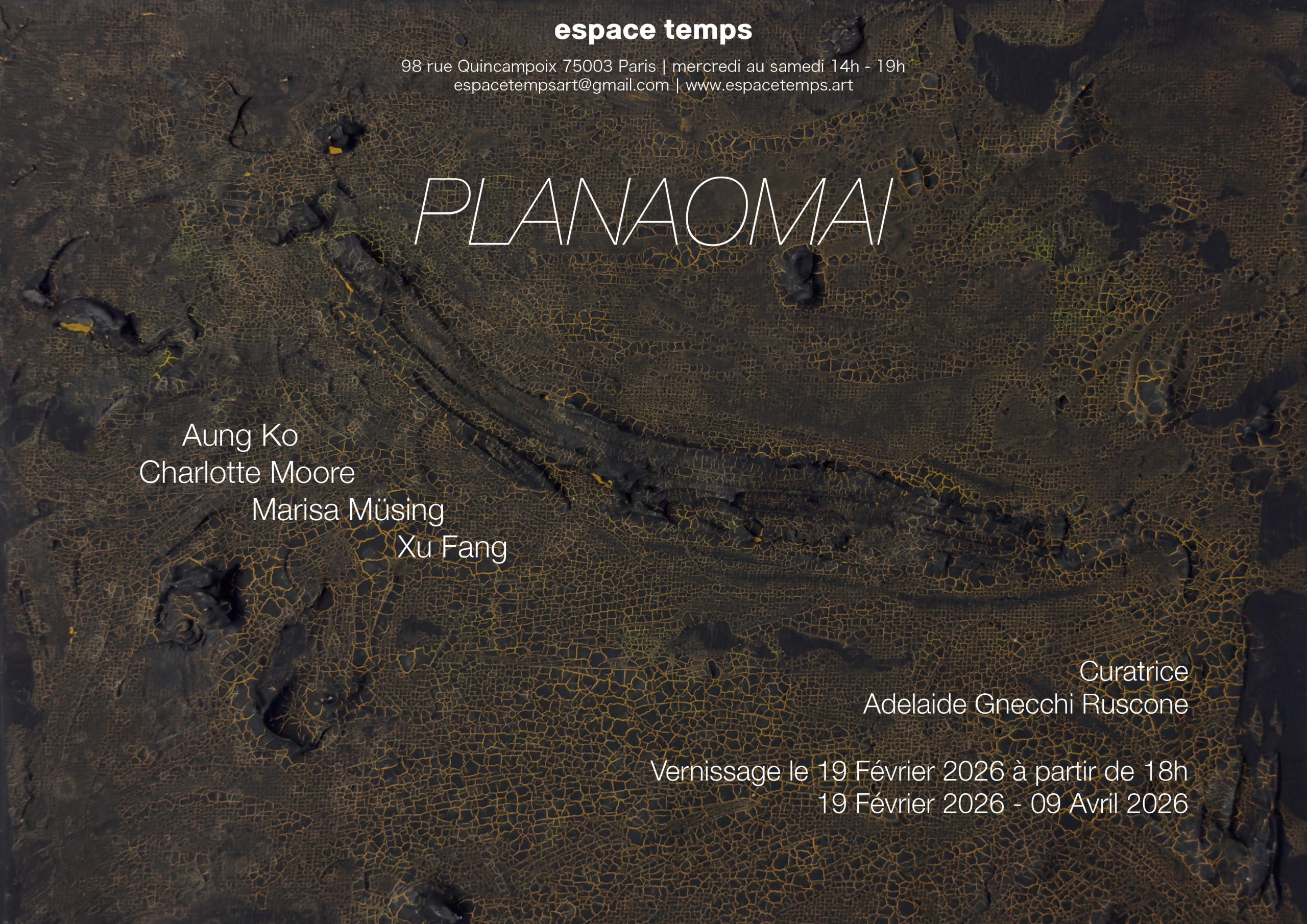
Planaomai
February 19/2026 – April 09/2026
Opening February 19/2026, from 6:00 PM
Artists
Aung Ko
Charlotte Moore
Marisa Müsing
Xu Fang
Curator
Adelaide Gnecchi Ruscone
Planaomai
If we consider the etymology of the word planet, which comes from the Greek planaomai, meaning ‘to wander, to lose oneself’, we might think of movement. The world would hence represent a state of perpetual change, a metamorphosis – in other words, it would not simply function as the stage for a located portion of its sphere, but rather be defined as an evolving matter. The exhibition in espace temps gallery thus opens onto a secret garden where each flower conceives its own breaths and transforms upon contact with the world. In this exhibition, the artists Fang Xu, Aung Ko, Marisa Müsing and Charlotte Moore resonate around the figure of the flower or microcosm, which become not only symbols, but an interconnection and symbiosis between different species. The exhibition traces how this moving phenomenon circulates, transforms, and carries both memory and metamorphosis. In this specific instance, the flower becomes a space for exchange and symbiosis, as defined by American biologist Lynn Margulis: an environment where different species influence and support each other. A surface of attraction, a meeting point with the unknown, a threshold. Where does the pollen from a flower fly to? What influence does it have on what it encounters? How can the environment transform?
Inhabiting the skin: interspecies negotiation and vital tension
In Fang Xu’s work, we enter the realm of a microcosm, a cocoon, an embryo — authors of a world-image unto itself. Here, the skin that separates us from the world is nothing more than the threshold through which we found relationships. Indeed, there is no separation; each being participates in a network interconnected by one same breath. The breath of the world that penetrates us and which we penetrate in return. Survival involves occupying or negotiating space. Human beings, as heterotrophs, survive by absorbing other lives. Italian philosopher Emanuele Coccia defines a theory of ‘mixing’ in which life cycles constantly evolve through different bodies.
Fang Xu is influenced by the materials she collects, assembling them through different configurations and letting them react over time: mould forms, colour changes with exposure to UVs, layers of skin decompose. In Burning My Skin, skin is not a simple shell or protective armour, but rather a living, sensitive and porous organ, capable of perceiving, repairing and allowing itself to be pierced. Beneath the first layer of the sculpture lies eucalyptus bark: a tree that must cyclically shed its surface layer in order to grow — ‘a slow but necessary violence,’ in the words of Fang Xu. How is life perpetuated through contact and transformation? How can destruction become an element of conservation? These questions recur in her work, where confrontation is neither spectacular nor solely violent. This process manifests itself through ordinary gestures, as in The Child Has Already Left, representing a pram becoming an abandoned cuticle. The individual is continually formed and transformed through the abandonment of a part of oneself or an object.
Throughout our lives, we shed our skin, separating ourselves from the layers of time. A reservoir and liminal point, a surface of contact and a zone of passage, the epidermis archives and transforms itself. Every body undergoes alterations; by decomposing, it becomes food for other forms of life, becomes mucous, moulders, becomes organic matter. Protection is always, in some way, destruction. In Io, beneath the black hide, the mould’s black pigment reduces the damage caused by the skull’s contact with sunlight by forming an additional layer.
The skin becomes an ambiguous threshold: protecting and separating from the outside world, whilst remaining the habitat of various forms of life, such as microbes or micro-organisms. Here, inhabiting means absorbing, consuming, occupying a space — spaces that are mostly designed and constructed by other agencies. Living, in a sense, means appropriating this space and negotiating a possible common area. In Fang Xu’s sculpture, skin becomes an environment of active metamorphosis, a negotiation between different organisms operating on the external layer: the theatre of a vital tension. In the words of Franco-Chinese poet François Cheng, life is quelque chose qui advient et qui devient. Returning to Coccia’s theory of mixture: during a body’s life cycle, the organism is susceptible to mutation, to formal change, and in turn modifies the other.
The garden as a shelter: metamorphosis and resistance of living beings
In Aung Ko’s After Black, we observe flower particles, sedimented memories, fragments of life — shards embedded in the skin that blend into the canvas, torn by black acrylic as if the surface were charred. The black in his works becomes almost impenetrable: the viscous and deep pictorial surfaces echo a traumatic past, that of a city — the artist’s own — torn apart until the urban scene becomes unrecognisable. Forced into exile from his city after the military coup in Myanmar in 2021, Aung Ko confronts deep, intimate and collective wounds through his practice, one he continues in Paris where he has been living for the past few years. His memories are filled with streets covered in coal, fires devouring houses and forests that have disappeared. His paintings, like open wounds, become material for re-elaboration. The artist draws inspiration from Buddhist philosophy, which finds purpose in the idea of rebirth and life cycles as a means to confront death. In such a tradition, flowers appear as protagonists of sacred rituals, often present in places of worship.
In dialogue with the paintings appears a series of extracts from a video that Aung Ko made in 2020, when he returned to his parents’ village with his daughter Dahlia. The extracts take us back to bamboo-building techniques for constructing rafts, an activity that runs through his childhood memories and which he now sees in a different light, accompanied by his daughter and the villagers. He reveals a personal and intimate archive, stemming from rupture and the need to find space for resilience. Aung Ko manifests the yearning for a place to preserve memories that survive long distances, as art becomes a vehicle for memory, continuity and transformation.
Upon their arrival in France, Aung Ko and his wife Nge Lay embarked on a therapeutic practice through gardening, transforming the Cité Internationale des Arts’ courtyard into an Eden — or, in other terms, a garden and space for refuge, peace and reconstruction. The word garden comes from the German Garten, meaning ‘enclosure’ (hortus conclusus in Latin). According to French biologist and landscape architect Gilles Clément, cultivating a garden is a way of protecting something precious. At the same time, as Emanuele Coccia reminds us, such an environment is the oldest form of life production, the milieu where plants made life on Earth possible by producing oxygen. In this sense, plants are the world’s first gardeners. In Ko and Lay’s work, the Shelter-Garden is conceived as a place of care, designed as a tribute to displaced lives, to artists forced into silence who live in exile as a permanent condition.
In After Black, these themes are further explored between the Palais de Tokyo ateliers, Cité des Arts, and the Beaux-Arts de Paris. The piece appears as dense material, created through a slow process of layering colours, successively covered with a layer of black acrylic. The shapes are reminiscent of tree trunks, mixing flower ashes into the acrylic. The black surfaces, resembling skinned entrails or burnt skeletons, refer to the artist’s native country, where the overproduction of coal punctuated daily life. Coal mining led to the disappearance of vast forests, and during the coup d’état, many nearby houses were set on fire, destroying hectares of these green lungs. Isn’t it thanks to plants that the planet’s continuous metamorphosis takes place: we breathe the world, and the world breathes us through this incessant transformation of which we are a part? From this perspective, it is no longer possible to distinguish nature from culture. Aung Ko’s work falls within this porous threshold, where trauma mingles with life, and where painting becomes an act of resistance, healing and metamorphosis. Life can be thought of as the collective reworking of an original trauma — that of the birth of the world.
When everything burns, we may witness an act of rebirth; flowers are already the beginning of rebirth, born from the ashes as the cycle of life resumes its course. From then on, viewers can traverse espace temps’ gallery spaces as a kind of garden that reveals a microcosm-image. When everything on the planet was in a liquid and sterile state, plants began to create a habitable space on the Earth’s surface by producing the oxygen that enables breathing; more than a zoological entity, the world is a vegetal entity.
Relational ecologies and hybrid morphologies
In the work of Charlotte Moore and Marisa Müsing, materials merge into one another, creating friction between two opposites: fragile, porous ceramics and resistant but oxidisable metal. From this encounter emerges a new species, an inter-being. These morphologies evoke living, hybrid forms in constant mutation, transporting us into Mercè Rodoreda’s imagination, to whom they pay homage. Her novels feature resilient flowers, charged with symbolic force, imbued with fragility, memory and survival. Rodoreda, a Catalan writer born in 1908, was forced into exile in France and Switzerland because of war and political repression. Her texts combine magic, symbolism and dreams. In her writings, nature — and in particular the plant world — becomes a space of resistance and transformation.
Müsing and Moore’s flowers inhabit this same imaginary tension and can be read as a space for speculative fabulation, as defined by American philosopher Donna Haraway. Haraway uses this term to refer to the ability to imagine possible worlds even in the midst of disaster, when narrative is no longer just denunciation but becomes a tool for creating new alliances and forms of survival. In the work, dialogue is established through the exquisite corpse, a surrealist technique that becomes a method of elaboration for Müsing and Moore. The result is a narrative in which otherness is transformed until it resembles itself. Ceramic, a raw material that comes from the earth where flowers grow, blends with metal. From this material tension arise hybrid forms, sculpting unexpected encounters between different species that collaborate to create an image of the world — or rather an image-world, vibrant and relational.
In today’s digital landscape, saturated by media where accumulation and slippage prevail, forms merge and contaminate each other in a diffuse strangeness. On the Internet, objects are transformed by collision: a dog’s head can merge with the root of a mimosa tree. In contrast, in the non-digital world, nature does not function through morphing, but through precise and localised connections, such as those created by weaver ants as they hang their nests from trees. The stories that emerge from these relationships are collective constructions, made up of delicate links between objects, species and environments. These forms respond to contemporary despair and offer a counter-narrative to what biologists now call the Miocene, the era of viscosity, where the collapse of ecosystems produces a confused, amorphous and undifferentiated world.
Thus, the triptych Dead Flower, Water Flowerand Mean Flower takes shape from the flowers that appear throughout Rodoreda’s stories. Through a dialogue between video, sculpture and wall pieces, Müsing and Moore compose an enchanted garden that transports us into a dreamlike dimension. Biological and artistic references — from fifteenth-century Italian herbariums (Erbario) to Goethe’s Urpflanze and Maria Sibylla Merian’s illustrations — feed into an iconography where science, imagination and plant memory intertwine.
As in an exquisite corpse, forms contaminate and influence each other. Life becomes chimerical, crossing bodies and species in an endless cycle. This dynamic crystallises in the image of the flower, through which the plant entrusts its future to other species. An insect thus becomes a geneticist, a breeder, a farmer; the flower does not merely cooperate with the bee, but transfers part of its plant intelligence into the body of another kingdom. Such a gesture is not simple collaboration, but the emergence of an interspecific cognitive and speculative organ, in which thought, reproduction and imagination unfold beyond any fixed boundaries. From this perspective, the alliance between flowers and the posthuman proposed by Müsing and Moore behaves as a sprawling thought, in which each element is connected to the others within a world-image.
PLANAOMAI thus unfolds like a garden in motion, where the works do not offer a fixed image of the world, but rather a relational space in the making. The flower becomes a vital space, a place where loss, survival and the possibility of other forms of collaborative living are negotiated. Nothing exists in isolation: forms, materials, imagination and narratives intersect, generating a sensitive ecosystem in which the human and the non-human coexist, creating collective metamorphoses.
Adelaide Gnecchi Ruscone
Artists
Aung Ko
Aung Ko was born in Myanmar in 1980 and went into exile in late 2021. He is a contemporary artist working across painting, film, installation, and performance. His work is an ongoing commentary on the political and social contexts of contemporary Myanmar, often exploring themes such as censorship, injustice, and power.
He has participated in Documenta 15 (Kassel, Germany, 2022), the Singapore Biennale (2008), and the 4th Fukuoka Asian Art Triennale. He was an artist-in-residence at the Pavilion, Palais de Tokyo (2014–2015). In 2024, he presented an exhibition and residency at Palais de Tokyo, followed by an exhibition at the Musée national de l’histoire de l’immigration (Palais de la Porte Dorée) in 2024–2025.
In 2007, he initiated the long-term Thuyédan Village Art Project in his home village. The village’s main source of income is charcoal production, and due to its isolation and the presence of a nearby ammunition factory, the inhabitants live in fear while visitors and publicity are generally forbidden. Together with his wife, artist Nge Lay, Aung Ko has invited artists to collaborate with the villagers through performances, mobile sculptures, and other collective artworks.
Charlotte Moore
Born and raised in the Tamar Valley, Cornwall, her practice is shaped by its post-industrial landscape of mining and agriculture. She examines how human activity drives botanical transformation, focusing on how plant communities reclaim abandoned architectures and terrains, and proposing new forms of human–nature coexistence.
Trained in architecture and working primarily in ceramics, she combines analogue and digital processes within research-led, site-responsive projects. Her work engages local communities and interrogates the ethics of archives, herbariums, and seed banks in the context of climate adaptation and biodiversity preservation. She is currently developing architectural ceramic research for a community seed bank supporting wildfire recovery.
Recent work includes Cornubia Tropicus (WhiteGold Project), exploring ecological shifts in former kaolin quarries in St Austell. The project received a CBG Award for “Use of Clay” and “Cornish Distinctiveness.” She is a recipient of the BLAZE TO BLOOM Award, British Ceramics Biennale 2025–2026.
She holds an MA in Architecture (Distinction) from the Royal College of Art (2019) and a BSc (Hons) in Architecture (First Class Honours) from Cardiff University (2015).
Marisa Müsing
Marisa Müsing is a transdisciplinary artist and cyber thinker exploring relationships between the body, digital identity and archaeological history, expressing ethereal feminist ideals through digital and sculptural media. Their PhD at the Royal College of Art reinvestigates Pompeiian frescoes through a queer cyberfeminist lens.
They have exhibited work at the Royal Academy of Arts, the British Academy, Salone del Mobile, New York Design Week, SOFTER, Ethereal Maison, Restless Egg and Xpace Cultural Centre, and have been featured in Glitch Magazine, Digital Frontier, Hypebae, WGSN, Dezeen, Vogue and the New York Times.
Marisa has lectured at institutions including the RCA Research Biennale Symposium, Parsons School of Design, Harvard GSD, Rhode Island School of Design and ELISAVA Barcelona School of Design and Engineering.
Additionally, Marisa runs two collaborative studios:müsing-sellés, a globally-recognised design and teaching studio engaged in the transformation of object and spatial design through architecture; and mamumifi, a multidisciplinary collective that explores building stories around identity through objects from mixed-asian female perspectives.
Xu Fang
Fang Xu’s practice revolves around a non-oppositional understanding of structure. In their work, oppositions are not conflicts that require resolution, but parallel outcomes of the same life process operating at different scales. Any action perceived as reasonable, necessary, or benevolent inevitably entails acts of appropriation, exclusion, and sacrifice at the very moment its legitimacy is established.
Within Fang Xu’s installation practice, action is continuous yet leads to no exit. Ants endlessly search for a way out inside light boxes; the system does not persist through collapse or enforced stability, but through limitation. From life to death, action is constantly propelled forward, yet its meaning does not lie in arrival, but in the compelled continuity of the process itself.
Plants continue to grow while being cut. The system is sustained through restriction rather than destruction. In this practice, cutting and protection do not negate one another. Survival itself implies ongoing absorption, transformation, and consumption, while distinctions between “good” and “evil” stem more from anthropocentric value judgments than from the internal logic of life’s operations.
Fang Xu’s work has been exhibited at venues including the Grand Palais Éphémère in Paris and Galerie Hausgeburt in Germany. Their long-term practice consistently centers on systems, cycles, and structures of life.
Curator
Adelaide Gnecchi Ruscone
Adelaide Gnecchi Ruscone (Milan, 1997, she/they) is an independent curator living between Venice and Paris. With a background in performing arts, her research adopts a transdisciplinary approach that she develops through collective practices of exchange and transmission of situated knowledge.
Her most recent project, Pensare con la Laguna. Tra scritture e pratiche veneziane, is a publication drawing on her living experience in Venice, that focused on wetland care and restoration. This work proposes an ecological reading that considers water as living matter and a cultural agent shaping thought, relationships, and imagination through a hydrofeminist and posthuman perspective.
espace temps
espace temps est un organisme qui se situe au coeur de Paris, à proximité du Centre Pompidou. Il est dédié à l’organisation d’expositions et d’événements de recherche, tout en favorisant les rencontres et les échanges.
98 rue Quincampoix 75003 Paris
Du mercredi au vendredi 14h – 19h
Le samedi 11h – 19h
espacetempsart@gmail.com