
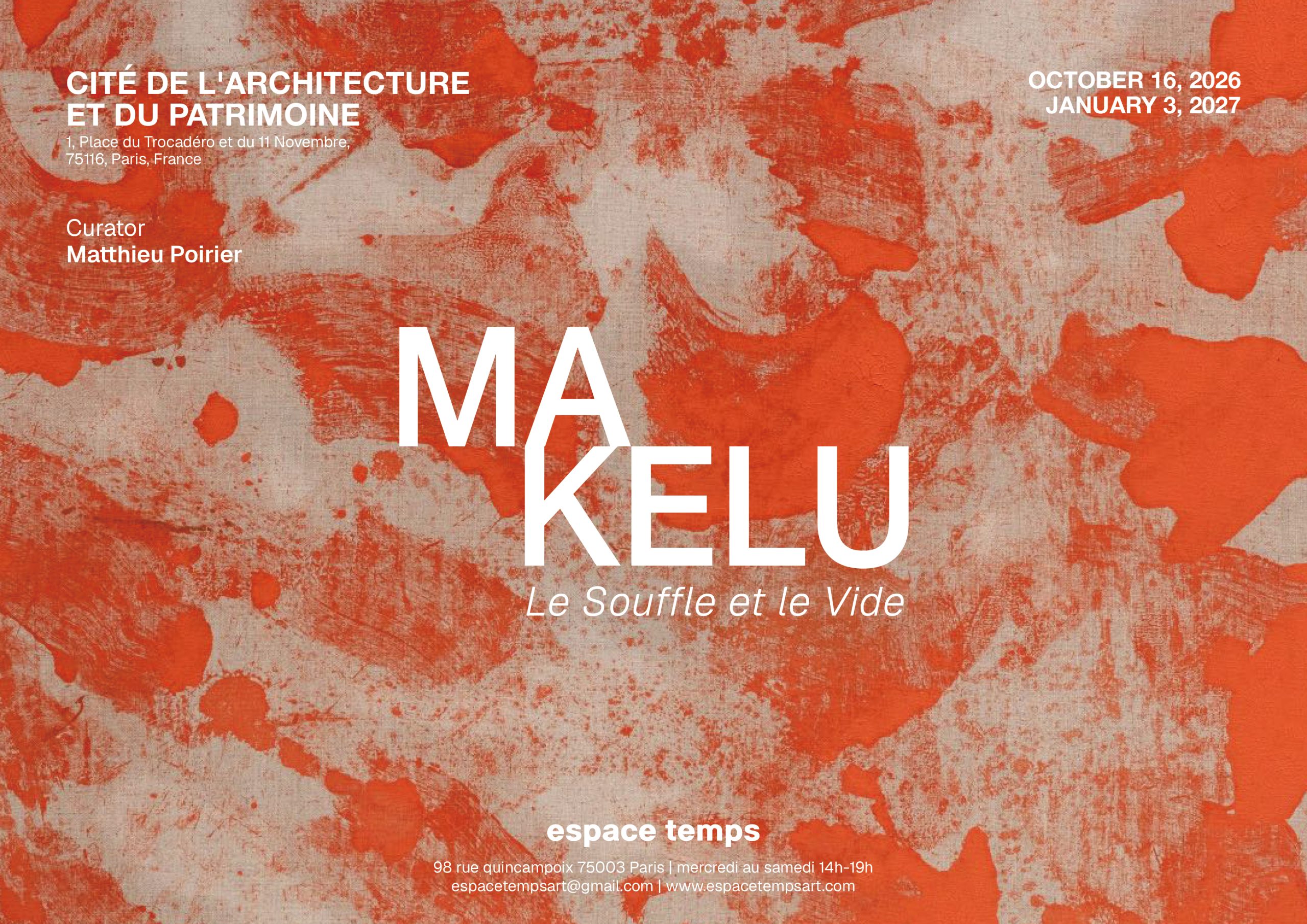
Breath and Emptiness
16 October 2026 – 3 January 2026
Venue: CITÉ DE L’ARCHITECTURE ET DU PATRIMOINE
Artist
Ma Kelu
Ma Kelu: Gesture, Color, and the Void
Matthieu Poirier, Dr. Pr.
At first glance, Ma Kelu’s recent painting offers little more than a series of marks and traces, jagged, nervous, and mostly monochromatic forms arranged in a grid across the surface of raw, unprimed, square canvases. Yet one must spend time with these surfaces to perceive their complexity. Their apparent economy of means resists the habitual categories of art history and calls for another way of looking: less immediate, more attentive to variations in color, traces of gesture, and the spaces between forms. This painting thus engages what one might call, borrowing from Merleau-Ponty’s phenomenology, the “flesh” of the visible: an experience in which the gaze no longer merely identifies forms but apprehends their emergence, disappearance, and transformation.
At the Sources of Seeing
Born in Shanghai in 1954, Ma Kelu was, in the 1970s, one of the founders of the No Name (Wuming) group, an underground collective that rejected the official Socialist Realism imposed by the Cultural Revolution. At the time, he developed a form of landscape painting centered on the sensory expression of subjectivity through light and color, under the influence of the Nabis and late Monet. The parks of Beijing, the narrow lanes of the hutongs, and the changing skies above the Forbidden City became sites of patient observation of atmospheric modulation. One can also detect, in a context where access to Western sources remained often severely limited, echoes of Cézanne, Bonnard, and late nineteenth-century landscape painting. This period is not merely a prelude to abstraction. It establishes a genuine ethics of looking: attentiveness to light, descriptive patience, sensitivity to variations in tone. As the motif gradually disappears, these concerns remain, shifting toward the surface and color. In this respect, Ma Kelu’s early works indirectly engage with the Impressionist and Fauvist origins of the term “Tachisme”, before it came, after World War II, to designate certain forms of gestural and abstract painting.
When the Landscape Fades
The transition to nonfiguration took place gradually during the 1990s, following the artist’s move to New York in 1988. Yet it does not amount to a simple conversion to American Abstract Expressionism. Ma Kelu moves critically through this field, retaining certain principles rather than its most spectacular effects: Rothko rather than Pollock, Frankenthaler rather than de Kooning. The color field, frontality, and concentration of the painting itself become the instruments of a personal investigation. The square format, which neutralizes gravitational orientation and breaks equally with the horizontality of landscape and the verticality of the figure, plays an important role in this transformation. This appropriation of Western abstraction is intertwined with a sensibility rooted in the Chinese pictorial tradition. The dilution of ink and the circulation of qi yun, the “vital resonance” that underlies part of classical Chinese painting theory, find an equivalent in Ma Kelu’s circulation of color and in the relations between appearance and disappearance. Abstraction is therefore not, for him, a rupture, but a distillation of the way of seeing developed during his early years.
The Cry and the Gesture
This evolution finds particularly clear expression in the Ada series. The generic title reproduces the transcription of Bruce Lee’s battle cry. For Ma Kelu, this exclamation evokes an immediate action, triggered without prior reflection. It thus establishes a link between the violent, liberating burst of kung fu, in its cinematic trope, and the immediacy of Action Painting, abstract automatism, and Lyrical Abstraction. The energy of the gesture is therefore not conceived as a composition worked out in advance, but as an eruption. It is concentrated in an impulse that must retain its force at the very moment it is deposited on the canvas. Yet this energy never results in a saturation of the surface. On the contrary, Ma Kelu contains it within the phrase “everything is there, but there is nothing,” which conveys a tension between energy and nothingness. The Void here is neither an absence nor a mere ground: it becomes a dynamic and active element, a site of transformation traversed by the vital breath of color. The artist thus calls for a “return of art to its ontological essence” and rejects the illusion of depth, gloss, and impasto. Even when the gesture is broad and powerful, the pictorial matter remains a thin film deposited on the raw linen, whose presence it never seeks to conceal.
Aperspective Land
The recent works, produced primarily since the 2000s, often take the form of monochromatic or sparsely polychromatic fields. Color is laid down in very thin successive layers, sometimes translucent, which seem to emerge from the support rather than simply being applied to it. Each layer modifies those beneath it and allows chromatic accidents to appear beyond the painter’s complete control. Without any perspective nor depth, the painting thus preserves the memory of its own process. This method introduces a particular temporality into the pictorial space. The broad, fluid, and irregular brushstrokes evoke clouds shaped by the wind or forms subject to an uncertain gravity. Their repetition according to an invisible grid gives each canvas the character of a progressive mutation: the same gesture seems to return, but never quite in the same form. These jagged silhouettes are therefore never definitive. They appear, surface, or dissipate, like so many traces of the passage of time. In this respect, Ma Kelu’s work may evoke certain investigations by Judith Reigl or Hans Hartung, without belonging to the same genealogy. The surface thus acquires a depth that is not that of perspective. It arises from stratification, transparency, and the accumulation of traces. Some works take on the appearance of a palimpsest: erasure does not completely eliminate what preceded it, but preserves its remnants. The image itself remains unstable. Populated by intermingled signs, the painting resists any fixed form and eludes a strictly formalist reading. The eye moves through the filaments of paint, between denser areas and more open ones, without ever being able to definitively fix what it sees.
The Surface as Threshold
One is reminded here of what Georges Didi-Huberman has called, in relation to Simon Hantaï, the “opening of painting”: its capacity to become a threshold rather than a closure. This idea makes it possible to understand Ma Kelu’s surface not as a boundary enclosing the image, but as a space of passage. The painting remains open to transformations of matter, appearances of color, and shifts in the gaze. It is in this logic that the importance of the interval emerges. It is not a neutral void or a mere spacing between forms, but an active, tension-filled site. In the sense François Cheng gives to the Void, and in the Chinese notion of jian (間), the in-between constitutes less an absence than a condition of relation. As in Henri Michaux’s ink works and paintings, the edges of each form in Ma Kelu’s work remain indistinct, while the nuances of a given color meet without merging, through shifts in the density of the medium that alternate between transparency and opacity. The breathing spaces preserved within the pictorial field thus become genuine crucibles of transformation. This poetics of the in-between, which gives rhythm to the constant mutation of the gestural motif, brings his work into dialogue both with certain developments of Color Field painting and, more broadly, with the grid-based deconstruction of the pictorial surface undertaken by the Supports/Surfaces movement. Yet Ma Kelu distinguishes himself from these genealogies through the restraint of his systems. Where certain forms of abstraction seek immersion or spectacular intensity, his painting favors a slower, more inward experience. Even though it is subjected to a mise en abyme through this constant modulation (at the expense of any definitive and authoritative mark), the repetition of the gesture is not mechanical: it produces shifts, variations, and a visual rhythm that reveals itself only as the eye lingers, as though reading a text or a musical score, but in an erratic manner, that is, in defiance of the usual order.
The Impossible Act of Seizing the Image
One must therefore accept, before a Ma Kelu painting, the need to relinquish immediate apprehension. A surface that initially appears uniform gradually reveals its differences: an almost erased brushstroke, a tonal modulation, an earlier layer emerging through, an area where the neutral color of the linen reappears. The more retinal color introduced by the brush gradually differentiates itself, and the painting seems less to present itself to the eye than to emerge through duration. This temporality is not unrelated to the legacy of Song Dinasty’s painting, which Ma Kelu claims as an inheritance, in which landscape is conceived as a space of relation between human beings, nature, and the vital breath (qi), and in which atmospheric modulation and the importance accorded to emptiness participate in a shared mode of vision. Painting becomes as much an experience of duration as a visual object.
Long remaining outside the principal narratives of post-Mao Chinese art, Ma Kelu’s work now occupies an increasingly visible place in institutional collections, notably at Tate Modern, the Guangdong Art Museum, M+ Museum, and the National Museum of China. This recent recognition does not alter the nature of a practice that developed on the margins of the logics of visibility and spectacle. Ma Kelu thus emerges as a painter of variation and the interval. His work seeks to make the surface a fundamentally uncertain space in which gesture, color, and the void remain in tension. In these paintings, where forms appear and disappear without ever becoming fully fixed, the eye encounters less an image to identify than an experience to prolong: a form of painting that makes the surface an event, color a duration, and systematic modulation a keen meditation on gesturality.
Artist
Ma Kelu
Ma Kelu was born in Shanghai in 1954 and later moved to Beijing. As a member of “No Name Group” (Wuming Painting Group), a Chinese contemporary art group formed in the 1970s, Ma has long been committed to practicing the concept of “returning art to its essence,” aiming to achieve total freedom in his artistic creation. He participated in the underground art exhibition in 1974 and the No Name Group’s public exhibition in 1979; by the early 1980s, he had become part of the experimental abstract art group in Beijing. His early landscape works went beyond mere plein air sketching, demonstrating a distinct artistic stance, research consciousness, and methodology in practice. He later moved to New York and studied at the Skowhegan School of Painting and Sculpture. In 2006, Ma Kelu returned to China, continuing to develop his abstractionist style with a broader perspective.
His works are in the collections of numerous international public institutions and private collectors at home and abroad, including the National Museum of China, Tate Modern (UK), M+ Museum (Hong Kong), HE Art Museum, Guangdong Museum of Art, Yuan Art Museum, Yinchuan Museum of Contemporary Art, Inside-Out Art Museum, and the Michael Evans Collection.